
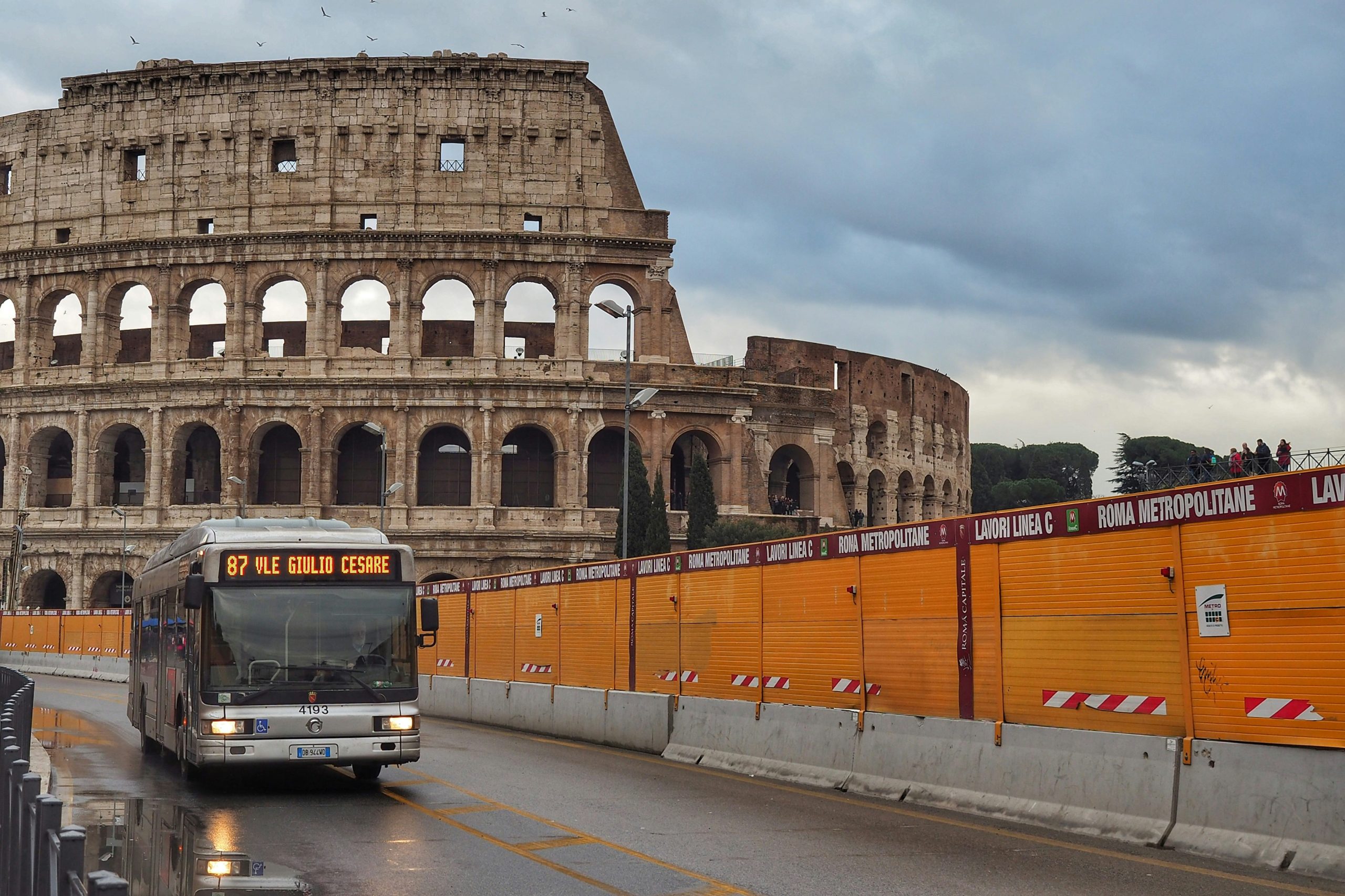
Rome is not an easy city to fit into a short itinerary: its historic centre contains an extraordinary concentration of monuments, but the places most visitors want to see are spread across several areas. Walking from one attraction to another may reveal beautiful streets and unexpected churches; it can also consume hours that were meant to be spent inside the Colosseum, the Pantheon or St Peter’s Basilica.
A hop on hop off bus in Rome can be worthwhile, particularly for a first visit or a stay of only one or two days. The important thing is to understand what the service can realistically do. It is most effective as the backbone of an itinerary, connecting several areas that can then be explored on foot. Used as a door-to-door service between every monument, it may actually slow the day down.
The question is therefore not simply whether a sightseeing bus is worth the price. Its value depends on the route, the stops selected and how well the bus journey is combined with walking.
Is a hop on hop off bus in Rome worth it?
For travellers with limited time, a panoramic bus can solve two problems at once: it provides an initial view of the city and reduces some of the longer journeys between major sightseeing areas. From the upper deck, it is also easier to understand how landmarks, neighbourhoods and archaeological sites relate to one another.
The service tends to be particularly useful for first-time visitors, families and people who do not want to cover every distance on foot. It can also help on the first day of a Rome trip, when travellers are still learning the shape of the city and may not yet feel confident with the public transport network.
It is less useful for someone planning to spend an entire day within one compact area. Travellers focusing only on the Pantheon, Piazza Navona, the Trevi Fountain and the Spanish Steps can complete much of the route on foot. Similarly, anyone spending several hours inside the Vatican Museums may have little time left to use a day ticket extensively.
A Rome hop on hop off bus makes the most sense when at least two or three geographically separate areas are included in the plan. The bus handles the longer connection; walking handles the detail.
Why Rome cannot be explored entirely from the bus
Rome does not reveal all its important places from a main road. Several famous attractions stand within pedestrian areas or along streets that large vehicles cannot use. Traffic restrictions and archaeological zones also affect where sightseeing buses can stop. This means passengers should expect to walk from the designated stop to certain landmarks. The Trevi Fountain, Pantheon and Piazza Navona, for example, are best treated as part of a pedestrian route rather than three separate bus destinations.
That is not a weakness of the system. Rome is a city where walking is essential: fountains appear at the end of narrow streets, ancient columns are incorporated into later buildings and small squares change character throughout the day. The bus is useful precisely because it can conserve energy for these sections.
The smartest strategy is to create clusters of attractions and get off once for each cluster. Waiting for another bus after every individual sight wastes time and prevents the itinerary from developing naturally.
How to plan a hop on hop off Rome itinerary
Before boarding, choose two or three priority areas rather than making a list of every available stop. A realistic day might combine ancient Rome, the historic centre and the area around St Peter’s Basilica.
The Colosseum, Roman Forum and Palatine Hill form one natural group. These sites are close together, but visiting them properly can take several hours. Travellers with timed Colosseum tickets should organise the rest of the day around that reservation rather than assuming they can simply arrive whenever the bus reaches the area.
Piazza Venezia can work as the starting point for a second walking section. From here, it is possible to reach the Pantheon, Trevi Fountain, Piazza Navona and Spanish Steps by creating a route through the historic centre. The exact order depends on the next planned stop, but there is little advantage in returning to the bus between each monument.
A third section can focus on Castel Sant’Angelo and St Peter’s Basilica. They stand on opposite sides of the Tiber but can be combined comfortably on foot. The Vatican Museums require more time and have their own entrance procedures, so adding them to an already crowded one-day itinerary can become unrealistic.
With this method, the bus does not dictate the entire day, it provides a flexible connection between areas that have already been chosen.
When to complete the panoramic loop first
Some visitors prefer to remain on board for a complete circuit before getting off. This can be useful at the beginning of a first trip, especially when there is no fixed museum booking that morning. The ride provides an overview and helps passengers recognise the location of the main areas. However, completing the loop first is not always the best use of a very short visit. Rome traffic can be unpredictable, and the time required for a circuit may change according to road conditions, public events and temporary diversions.
If there is only one day available, it may be better to start with the highest-priority attraction and use the panoramic section later, perhaps when energy levels drop. For a two-day visit, taking the full ride early on the first day becomes more practical because there is still time to return to the places that seem most interesting.
The decision should be based on the itinerary rather than treated as a rule. An overview is valuable only if it does not cause the traveller to miss the places they came to see.
Choosing between different Rome sightseeing bus routes
Not every visitor wants the same version of Rome: some are interested primarily in the classical monuments; others prefer museums, neighbourhoods or food. A route designed by an operator with local knowledge can reflect these differences instead of forcing every passenger onto one circuit.
Green Line Tours, a Rome-based company, offers three connected itineraries rather than a single undifferentiated route. Its Green Route covers many of the city’s principal landmarks, while the Orange Route extends towards the Pyramid and Testaccio, an area strongly associated with Roman food culture. The Blue Route is designed around museums and less obvious attractions, including the MAXXI and Borghese Gallery area.
These options are a useful example of how a Hop on Hop Off Bus in Rome can serve different travel interests. A first-time visitor may rely mainly on the central route, while someone returning to Rome could use the other lines to reach places beyond the standard circuit.
The routes should not be treated as interchangeable, however, since some connections operate with different frequencies and during specific hours. Anyone planning to use more than one line should check the current timetable and interactive map before setting out.
Thinking in groups of attractions produces a more efficient hop on hop off Rome itinerary and reduces unnecessary waiting.
How much waiting time should be included?
The advertised duration of a route is not the same as the time needed for a hop-on hop-off day. Every exit introduces three variables: the length of the visit, the walk back to the stop and the wait for the next vehicle.
A useful approach is to leave a buffer before any timed entrance. If a Colosseum or museum booking is fixed, do not plan to arrive at the nearest bus stop only a few minutes beforehand. Walking from the stop, finding the entrance and completing security checks all take time.
The interactive tracking service offered by agencies like Green Line Tours can help passengers decide whether to wait or continue walking, but it does not eliminate the need for a realistic schedule. Flexibility works best when the itinerary contains spare time.
Which hop on hop off Rome ticket is most useful?
The right ticket depends less on the total number of attractions than on how often the bus will genuinely be used. A traveller planning three carefully selected stops may not need the same option as someone using the network over two or three days.
A daily ticket is suitable when all journeys will take place between morning and evening. A 24-hour ticket is different because its validity begins with the first use and continues into the following day. That distinction may matter to someone arriving in Rome during the afternoon, or if you want to experience the night atmosphere with a Rome night tour bus.
Longer tickets can suit travellers who prefer a slower itinerary or want to divide museums, ancient sites and neighbourhoods across separate days. A limited-pass option may be more appropriate for those who already know exactly where they want to get off. Current conditions and prices should always be checked directly before booking. The useful calculation is not “How many times could I board?” but “How many journeys will save meaningful time or energy?”
Practical tips for a Rome open top bus tour
The upper deck offers the best panoramic view, but during summer, the middle of the day can be uncomfortable; sunscreen, water and a hat are sensible even if most of the sightseeing will take place from the bus.
Seats downstairs provide less dramatic views but may be preferable during very hot weather or after several hours of walking. Changing decks during the day can make the experience more comfortable.
Finally, audio commentary is more useful when travellers can hear it properly. Bringing personal earphones, when compatible with the system, can be more comfortable than relying on unfamiliar disposable ones.
Is walking or a Rome panoramic bus better?
The two approaches are not rivals. A good short Rome itinerary uses each where it performs best. Walk between the Pantheon and Trevi Fountain; use the bus to connect that area with the Colosseum or another part of the city. Remain on board when the route itself offers useful views, then get off where several places can be explored together.
A hop-on hop-off service provides structure, reduces some tiring transfers and helps a first-time visitor understand the city.
For a short trip, the Rome sightseeing bus is worth considering when it supports a selective itinerary. The objective is not to hop off as often as possible, but to spend more of the day in the places that matter.